February 3, 2026
How Businesses Can Stop Losing Leads?
AI Chatbot Implementation Case Study
For more than four years, I have been designing and developing websites, working with both Russian and international clients. Recently, we built a website for Enterio, a company that has been providing designer apartment renovations in Moscow and the Moscow region for over ten years.
**The project was created on** Webflow, a platform I often use in my work. The goal was to build a lively, interactive website that not only sells services directly but also reflects the company's values and spirit.
The result was great. Almost immediately after launch, the website started receiving organic SEO traffic, and the client was happy. But I still felt that something was missing.
I had been thinking about this for almost a year. I realized that websites alone do not bring much value to a business if they are not integrated into broader business processes.
Some time after the project launch, the client reached out to me with an idea:
"Dima, can we try implementing an AI chatbot on the website and in messengers? It should talk to visitors, know everything about the company, collect leads, book meetings, and send everything to Bitrix."
That was the moment something clicked. What inspired me was not just the chatbot itself, but the opportunity to move into a new area: business process automation.
Everything suddenly came together. This is what truly creates value for businesses. This field is clearly trending, and the idea of a future where internal company processes run automatically, without constant human involvement, genuinely excites me.
The Problem
I began researching how to best implement such a solution. Many companies use no-code automation tools like n8n, Make, Zapier, and others.
However, in practice, these tools have significant drawbacks:
- they are difficult to scale and debug;
- you do not own the source code;
- you become dependent on the platform.
For this project, I wanted to build a modular and scalable architecture that would allow us to:
- easily add new functionality;
- extend automation to other departments;
- change tools without pain or vendor lock-in.
That is why we decided to build everything with custom JavaScript and wrap the project in a Docker container.
The Solution
Technical Foundation
At the testing stage, we did not want to spend too much time building a chatbot from scratch, so we used Flowise as a base. It works similarly to n8n, allowing you to assemble custom logic from modules. The key difference is that Flowise is specifically designed for chatbot solutions. It can be self-hosted for free and later replaced with a fully custom chatbot if needed.
Infrastructure
Next came the infrastructure question. We needed to use OpenAI API and other AI models without VPN, including from Russia. Servers located in Russia were not an option. We chose Fornex and rented a virtual server in Germany, where the project was deployed.
Chatbot Flow
Here is how the chatbot core logic is structured in Flowise:
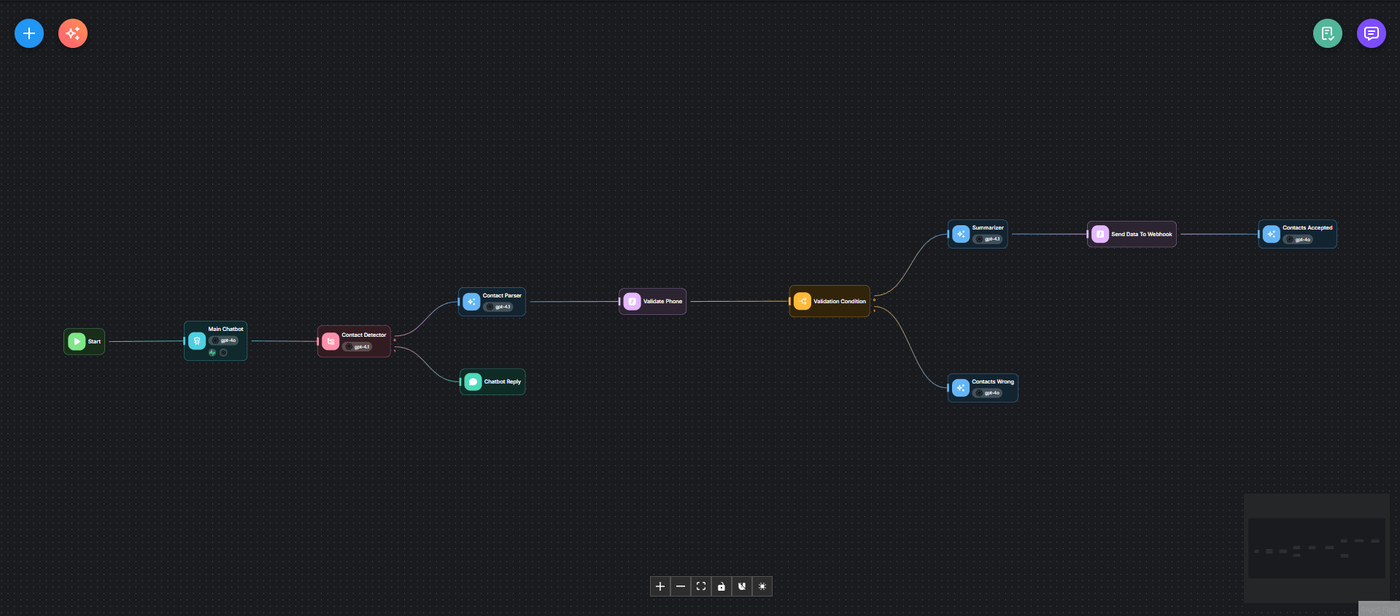
- Main Conversational Agent. This is the bot that communicates directly with website visitors and messenger users. It uses the GPT-4o model with a system prompt defining company context. The bot is connected to a RAG vector database containing company documents.
- Contact Detection. A secondary bot monitors each message for contact details like phone numbers or emails. If contact details appear, the next logic chain starts.
- Parsing Contact Data into JSON. This step prepares the data for validation and CRM transfer. The system searches the entire conversation history and messenger profile to extract the name.
- Contact Validation. A JavaScript function checks whether the phone number matches the Russian format. If not, the AI politely asks the user to double-check it.
The chat is embedded on the website via a lightweight script. The same flow is then duplicated for messengers using custom integrations with Telegram and WhatsApp APIs.
The logic is straightforward:
- A user messages the bot in Telegram or WhatsApp.
- The message is sent to Flowise via API.
- The response is returned to the messenger via API.
WhatsApp was more challenging. Even when attempting registration via a Georgian number, the account was banned. As a result, we used Wazzup and routed all WhatsApp interactions through their API and proxy, which worked successfully.
Results
The company now has a personal AI sales manager and consultant that communicates with clients across three main channels: the website, Telegram, and WhatsApp. It answers questions, gently sells services, books meetings, and sends all relevant information to Bitrix.
Final Thoughts
As I mentioned at the beginning, I see enormous value in solutions like this for businesses. This is a global trend that is already reshaping the market. Companies that do not start automating their processes today risk falling behind.

Dmitry Zozulya
Product Designer (UI/UX) | Developer